
Celebrate à la française en décembre

Le Réveillon is the name for both the main Christmas meal on Christmas Eve, and for the dinner on New Year’s Eve. It comes from the verb ‘veiller’ – ‘to stay awake’ or ‘to keep vigil’.
Le Réveillon de Noël : This is celebrated on Christmas Eve with a long, usually family meal concluding with the traditional dessert, and then the midnight mass.
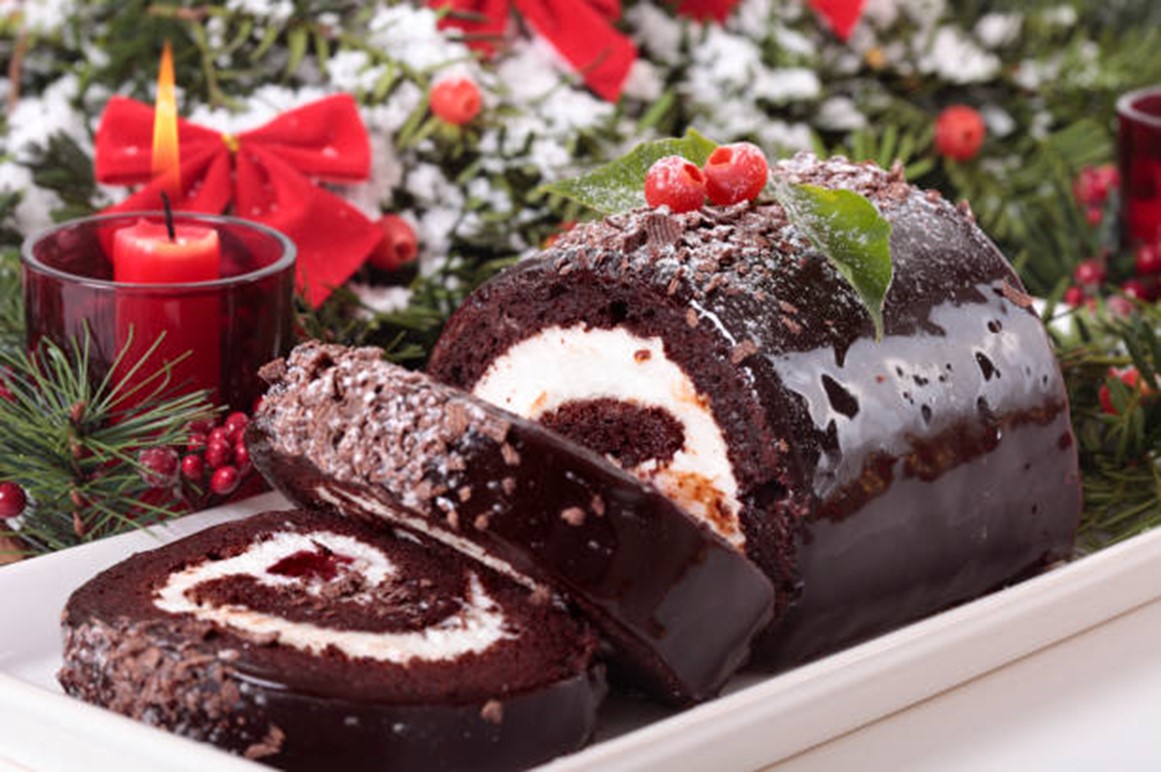
La Bûche de Noël : The traditional dessert is the Christmas Log. Slightly less conventional: Check out some non-traditional Christmas logs.
Les Treize Desserts : However, in Provence, there is also the tradition of the 13 desserts which represents Jesus and the 12 apostles. The desserts are nuts, dried figs, raisins, dates, quince paste (jelly), candied fruit, fougasse, traditional white nougat, black nougat (caramelised honey & grilled almonds), red nougat (rose flavoured with pistachios), Calissons from Aix-en-Provence (sweets made with candied melon & almond paste), oranges, clementines or mandarins, and watermelon.
Le Réveillon de la Saint Sylvestre : December 31st is the feast day of St Sylvestre, hence the name.
New Year’s Eve is celebrated with friends, good food, champagne, and firecrackers. At midnight, people wish each other « Bonne année ! » in the street with lots of noise. One other tradition often reserved for this day is « le baiser sous le gui » (kissing under the mistletoe). In Paris there is a sound and light show projected onto the Arc de Triomphe with a grand firework display at midnight.
Une chanson pour le Nouvel An : Bonne Année from Les Créoles Les Étrennes
Les Étrennes – which roughly translates as a “surprise” or “mystery gift” – are envelopes of money given, at the end of the year, as a little thank you to people who make your life easier – postman, bin collector, cleaner, concierge etc. Have a look at this video clip in French, pop on the subtitles and see how this tradition can be problematic in France.
Advance notice for January
La Fête des Rois : The festive period ends with l’Épiphanie, the day when the traditional galette des Rois is shared. It is always celebrated on January 6th and commemorates the presentation of the infant Jesus to the Magi or the three wise men. La galette is a sweet almond-flavored custard-filled pastry that has been around for around 700 years. A small figurine, la fève, is hidden inside. The person who finds la fève becomes King or Queen for the day (or goes to the dentist if they’re unlucky!)…. However, there is no fève in the galette eaten at the Palais de l’Élysée, the official residence of the President of the Republic. It is considered contrary to the principles of a republic. During the French Revolution, there was an attempt to rename the galette the Galette de l’Égalité, but this name was short-lived.
And for some of the International Days to celebrate in December, click here.

